Posts

Showing posts with the label antinomian

Unclear but present danger

It is now evident that Christians unhappy with Christian progressivism will "walk apart," as one catchphrase puts it, separating themselves in worship and in polity from what they see as heresy. The heresy they see is an antinomian view of gay marriage and abortion, along with other symptoms of an ugly syncretism of culture and church that imports the culture's unbiblical ethics into the church. These conservative Christians see in their opponents a rejection of scripture's authority and the lessons of tradition. They will walk apart for the foreseeable future, hoping for changed hearts in those on the other side of the controversy, and awaiting the judgment of history. It seems like a solution that will do for the time being, though no one is really happy with it. But the devil is the subtlest creature we meet with. There is a trap. Among those Christians rushing away from antinomianism are some who embrace, instead, a mechanistic and legalistic understandin...

The Protestant disease

The disease decimating mainline Protestantism has two main symptoms: Cheap-grace antinomianism that holds forth the promise of forgiveness, without issuing the call for amendment of life. Thus, only half of the message of grace is preached, the more appealing part. "Shall we continue in sin that grace may abound?" Well, yes, for who are we to judge? After all, judge not! This fatuous self-excusal from seeing ourselves as moral failures leads to a distorted understanding of reality, for from time to time we all fall down morally, and there is none of us who could not do with a bit more holiness. Social syncretism. The mainline senses the spirit of the age and confuses that with hearing the Holy Spirit. Societal causes and movements are force-fit into a Christian frame. The loud debate about the authority of scripture is really a debate about this. For example, the church now feels an imperative toward marrying homosexuals to each other, the scriptures do not provide fo...

Pop Christianity

Image
I am pleased to report that many people of my acquaintance, pastors and teachers in various denominations, are speaking out against lightweight, cheap grace, thoughtlessly feel-good Christian sentimentality, and against the moral lawlessness that frequently accompanies a gospel of all sunshine and lollypops. A gospel that speaks as if the Christian life is free of trials and torments and troubles makes me wonder just how that is even slightly plausible, but there is an answer of sorts in Hebrews 12:7-8. via  http://www.whatisthegospel.org.uk/ A related ill in the church world is thinking that it is not nice or proper to talk much about our trials. That idea is all wrong--we should talk more about our trials. If we do not tell others what is going on with us, we may lead other people who have troubles in life to think their problems are somehow new and different, despite 1 Peter 4:12-13. It is not quite a matter of misery loving company, more a matter of helping others ...

Just as I am

Image
via  Facebook I have remarked before on the lite beer antinomianism in which the preaching of God's grace makes people complacent about their sins. There is no progress toward amendment of life because God's grace has you covered. It is a simpleminded little transactional model in which God pays off our tab as we run it up. The message is insidious because it is so nearly the gospel, and it is easy for anyone to understand. Thus, it is readily accepted as the truth. But God's grace should be leading us (even if quite slowly sometimes, for we drag our feet) toward greater holiness, not complacency about our unholiness. That is not to minimize the troubles I and others have with besetting sins which, for some, become a combat of a lifetime's duration. But we are fighting, that is the difference. We do not shrug at our sins. Sometimes the message of God's grace is orthodox when it comes out of the preacher's mouth, but turns antinomian as it enters ...

Tales from the crypt

Image
Presiding Bishop Michael Curry As you perhaps know already, the primates of the Anglican Communion just concluded a week of closed-door meetings in the crypt at Canterbury Cathedral. The Episcopal Church, USA, was censured for moving forward with gay marriages, counter to the doctrine of Anglicanism in general. It is a clear affirmation of historical orthodoxy by the Anglican mainstream, but the rebuke was a lighter one than some traditionalists wanted. Here is the sentence passed upon the Episcopal Church by the gathered primates: “It is our unanimous desire to walk together. However given the seriousness of these matters we formally acknowledge this distance by requiring that for a period of three years The Episcopal Church no longer represent us on ecumenical and interfaith bodies, should not be appointed or elected to an internal standing committee and that while participating in the internal bodies of the Anglican Communion, they will not take part in decision making on ...

Meanwhile, in Germany...

Pastor Olaf Latzel of Bremen, Germany finds that the church scene in his country is soft on truth, soft on gospel fundamentals. He is trying to wake things up. In the process, he is getting flack for saying things that once were unremarkable when said by Christians. Story via CBN, read it here: http://www.cbn.com/cbnnews/world/2015/October/Pastor-Pays-Price-to-See-Germanys-Spiritual-Revival/

Misusing grace and law

Image
"The twin heresies, antinomian and legalist, are not two extremes with orthodoxy in the middle, but aberrations that deny the gospel, each in its own way. They are mirror opposites of one another but reflect only distortions." Here is a scripture that reveals a great deal about the nature of law and grace, and it occurs in the Old Testament. Examining it may surprise some people who think law versus grace is entirely a New Testament issue. 2 Chronicles 30:17-20 New International Version (NIV) Since many in the crowd had not consecrated themselves, the Levites had to kill the Passover lambs for all those who were not ceremonially clean and could not consecrate their lambs to the Lord. Although most of the many people who came from Ephraim, Manasseh, Issachar and Zebulun had not purified themselves, yet they ate the Passover, contrary to what was written. But Hezekiah prayed for them, saying, “May the Lord, who is good, pardon everyone who sets their heart on seeking ...

Anglican soap opera

Image
Interesting summary in the online Washington Post about the ongoing soap opera that Anglicanism has become. Those interested in Christian unity are well advised to study schisms taking place right in front of them, in their own lifetimes, not just historical schisms. Excerpt: The Anglican Communion is already divorced  By Trevin Wax | Religion News Service September 21   Is the Anglican Communion about to split over different views of sexual ethics?   You might think so after reading headlines about the archbishop of Canterbury’s proposal to “loosen” the structures of the Communion — a way of retaining his relationship to the liberal wing of the Western churches as well as the traditional Anglicans of the Global South.    But to interpret the archbishop’s recent announcement as a split over sexuality is to miss the bigger picture. . . "  Read more:  The Anglican Communion is already divorced (COMMENTARY) - The Washington Pos...

I'm a Christian, but...

Image
Nice takeoff on the rather vapid "I'm a Christian, but..." theme that is running around on the Interwebs these days. Hat tip to Lutheran Satire  for skewering this silliness right where it deserves.  .

Fire and brimstone

It is a strikingly odd thought. You can work for Christian unity by preaching the wrath of God, for doing so is a corrective for both antinomian and legalistic heresies. There is an appalling tendency in some circles to preach about God's mercy without preaching about his wrath. As a friend of mine says, "If not for the wrath you don't need the mercy." That is very astute. Salvation is being saved from something. It is not only being saved from our own folly either, but from eternal consequences of that folly. It is fashionable to preach in an antinomian tone that suggests that all of the gospel is sweetness and light. That kind of preaching is not the whole counsel of God. It leaves the hearers thinking that bedrock Christian ideas about right and wrong are sort of optional and nice and it will be no great problem if you continue to do your own thing. God's grace will cover it, surely? That is a point of schism in the church world. If you do not take note...

A truly awkward question

Image
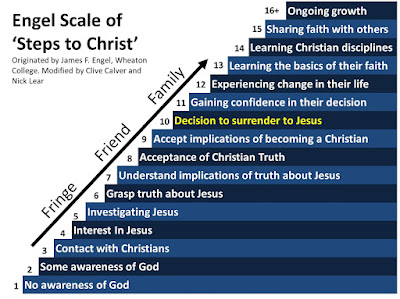
This is, as you see, the Engel scale, which tries to explain and gauge individual progress on the spiritual journey. Looking at it this morning I asked myself whether the same scale might apply to churches as well as individuals. I sometimes think of alarming questions, and this one alarmed me very much. What if there are church congregations that are nominally Christian, but in their preaching and teaching, and in the understanding possessed by the members, fall somewhere below ten on the scale? If there are some churches that are pre-Christian on this scale, but calling themselves fully Christian, then that has big implications for church unity. How can we unify with a church that is something other than what we ourselves mean when we say "Christian"? For it is clear that we and they would mean different things by it, if we are above and they are below step ten. In the hypothetical pre-Christian churches I am talking about, disciple making would be absent...

Squishy, limitless, radical grace

Image
Grace is given to us not so that we can excuse our own sinful purposes but so that we can fulfil God's higher and better purposes for us. The misuse of God's grace to excuse (not only forgive) things God calls sin is the problem leading to schism. "Go and sin no more" turns into "go and sin."  Love does not mean that one is infinitely indulgent. God is infinite in love, but his word promises us either his mercy or his wrath. Of course it does not diminish the goodness of God that some people will not like their eternal outcomes. God is good, whether or not you choose to join into that with him. We risk doing the sinner no good,  but harm instead, when we assure him that whatever his moral failings, God's grace is sufficient for him. While saying so is true in a very real sense, it is dangerously misleading if the statement is not carefully qualified. Antinomianism is false, after all, and it comes to us speaking those very same words. It is dange...

Immutable

If the gospel is indeed once given for all (Jude 1:3), then we do not have the option to adjust what it says to suit us better. If a thing is the truth, it is true whatever you think of it. If you have trouble with what it says, welcome to the club, for parts of the gospel are challenging to all of us. We may not all be challenged by the same parts, but all of us have to make some concessions and accept changes in ourselves as we become Christ's followers. If that were not true, there would be no reason for moral teachings to be given to us, because we would already be Christlike. That is a point that seems useful to emphasize--that we all need to change in the face of unchanging truth. There are many in today's church world who see it differently, apparently not believing in immutability as a characteristic of divine truth. I think their error is very great, and extremely dangerous to them. It is also destructive to unity among Christians. If you have one group that accep...