Posts

Showing posts with the label enlightened ignorance

What everyone knows

"It is when Christians connect with fellow Christians on the basis of their own direct and personal spiritual experience that we fully realize our spiritual kinship." Unreligious people sense on some level that God exists. Something exists, at any rate, of which they are aware. They may speak of conscience informing their hearts, or of nature bringing them a sense of awe and wonder, or of love as powerful in their lives, but they will not go the next step. In whatever ways they explain such signs, they will not say there is an unseen intelligence in back of it all. Currently, it is fashionable among the unreligious to suppose that conscience is a social reflex evolved to protect people from themselves and each other. Nature, they say, is an amazing display of random processes working over time. It awes us because we are part of it and so, naturally, it is bigger and more complex than we. Such answers make it unnecessary to look beyond the here and now for explan...

You can do all that in C

In real life I program computers. Programmers have favorite computer languages. Mine is C, and I can always start an argument by saying we don't really need other languages. People who have other favorites then take umbrage and start a debate. It is common in the tech community to refer to such kerfluffles as religious conflicts, and that is unfortunately apropos. The parallelism with religious debates is striking. People describing the same things in different ways, pursuing the same answers by different means, instinctively see one another as doing something wrong. I say that a program variable is, in reality, simply a numbered position in the computer's memory, what is called in computerese an address. That is the wrong way to look at it, say proponents of the higher levels of abstract symbolism. What is important, they say, is meaning.  We sound like a bunch of theologians. I am coming round to the conclusion, after years of thinking about it, that ...

Hanlon's razor

"Never attribute to malice that which is adequately explained by stupidity." Wikipedia on Hanlon's razor: https://en.wikipedia.org/wiki/Hanlon%27s_razor On razor principles in general:  https://en.wikipedia.org/wiki/Razor_(philosophy)

Toward a solution. Part five: The Roman mistake

In the medieval era, Roman Catholicism became fascinated by elaborate reasoned arguments and took them to be the gold standard of theological truth. When the Protestant Reformation happened, the Protestant sects carried forward this tendency. Now there were several strands of argument, each claiming superiority. There is an underlying assumption in all of this that having the better argument means you have the better truth. I see this as an error of the Roman church, inherited by her Protestant daughter churches. Or, to put it another way, Protestants felt that in answering Rome they needed to be sophisticated in their arguments. It was, in their understanding, the way that theology needed to be done, with lots of complicated details worked out. The result? Root and branch, Western Christianity is obsessed with the intellect. Where this becomes a problem is at the point where intellectual justification supports unloving attitudes and actions. In the name of reasoned argument...

Toward a solution. Part four: Adiaphora and enlightened ignorance

I have previously praised the Anglican demarcation of adiaphora, the most robust in all Christendom. I think everyone should adopt it, for it does not oppress minority views or unduly elevate the importance of the majority. Whatever else that church has gotten wrong, they are right about this. If a thing is not plain in scripture, it cannot be claimed as necessary to salvation, for the scriptures are clear about their claims in the matter. If we say something is necessary beyond what the apostles preached, we make them out to be false. In these pages I have used the phrase "enlightened ignorance" for the commendable practice of not supposing one's own understanding is going to be acceptable to everyone. Cultural differences and epistemic tendencies that vary with era, place and education mean that what is convincing to one person may not be to another. "One person considers one day more sacred than another; another considers every day alike. Each of them should be...

Toward a solution. Part two: Pillars and posts

I think most posts I make here from now on will be on the following pillar concepts. While it is always possible for God to surprise me, I think that future progress toward a unified Christendom, whatever shape that progress may take, will require our attention to these points. Learn the limits of intellect. If our strivings at wisdom result in division, just how wise does that show us to be?  Honor Christ's new commandment. Stop evading it by conflating it with "Love your neighbor as yourself." It's a different and more challenging concept.  Make the visible unification of Christendom your honest goal. Some people, if they were honest, would prefer keeping their own fiefdoms.

All things to good?

Tha apostle Paul assures us that God works all things to good for those who love the Lord, who are the called according to his purpose. On its face that is at times hard to believe.  Much happens that seems productive not of good but ill. The thing was written to encourage faith but it is capable of stirring doubts as well. But what if, in some circumstance, the good produced is not your own good? A friend of yours sees you bearing up under grievous trials, is impressed thinking that Christians have courage, and becomes a Christian himself. You have gained a friend for heaven and the future, and one would surely call that good. Or perhaps troubles that seem, in the present day, to be only harm and hurt are teaching you some lesson that will useful in the future. Perhaps when young you get injured badly and learn lessons in wound care in the worst way (but the way that teaches best), and later on, you will comfort someone else who is hurt or even save his life. ...

What the angel said

The angel said to John, "The testimony of Jesus is the spirit of prophecy." I always find that idea staggering, though I can see in the abstract that it has to be true. I and you and all the rest of the Christians are carrying around something holy and world-changing. The gospel's power to change hearts and lives is in God's Spirit, and we are charged with carrying the message around. No angel ever said that the reasoned disputations of theologians are the spirit of prophecy. I suppose my point lately has been that God's truth works sometimes through, but sometimes despite our human understandings, for it is higher than our thoughts and our ways, and we should be pleased if only our intellects do not draw us too often into an embarrassing lack of real insight. Did you ever wonder why the apostle Paul said the peace of God passes all understanding? What he said is a clue to something I try sometimes to say in these pages. There is more going on than we account ...

Doing, saying and thinking

Our Lord Jesus had something very revealing to say about false prophets: You shall know them by their fruits. He did not urge us to analyze the fine points of their reasoning or fault their grasp of systematic theology. Whatever they say, what they do won't turn out right. Notice that by pointing us to a test on that basis, he levels the intellectual playing field. Believers who might be fooled by a glib spokesman for a false idea need not be. They need only watch the result. I put a lot of stock in the test of results. I have seen Christians whose grasp of theology I find a bit lacking do works of mercy and kindness that make me take my hat off. I have also seen clever theologians support ideas that are unwholesome in practice when you look at what interests are actually served. In this connection I would cite recent Episcopalian revisions to the rite of marriage, which appear to be unhelpful even to those the revisions are meant to gratify. So even after we h...

Toward a solution. Part One: Overthinking and its alternative

We cannot say "In essentials unity, in nonessentials liberty, and in all things charity" until we agree on what is, or isn't, a nonessential. Only one church has had the courage and foresight to hold an ironclad definition of adiaphora. I have now been thinking long enough about the problem of Christian unity to see the way forward to a solution. The first step on the journey is to find out what an essential of the faith is, and what is nonessential. Christians everywhere, and particularly those in the West, way overthink things. We have taken the simple offers and assurances made by the Savior and over-complicated them, sometimes in efforts to reassure ourselves that we really can believe them. The heavy-handed scholasticism of the medieval era gave way to a free-for-all in the Reformation era, as churches defined their differences from Rome, and each other, by means of often tedious philosophical demonstrations that, often, left Christians farther from one ...

Beyond rational

Image
My thinking has veered in an odd direction due to some life trials that made no sense. If we are to trust God even when life takes on an absurdist air, when try as we might we cannot make sense of what is happening, we should ask what that says about our rationality and the role of intellect. There are times when our understanding fails us and only faith avails us anything. Finding that out has changed the way in which I approach ecumenism, and everything else. I was dropped into a series of circumstances that were on an objective level unreasonable, by which I mean they made no sense to me and would make no sense to anyone. I was tempted by the falsehood I have already described in these pages as the "bad daddy argument," in which we ask something like "where is God when things are so messed up?" One may even cry out, "Oh God, how could you?" Then the tempter invites us to conclude that God is not really there, or if he is, not on our side after all. ...

Examine yourself

St. Paul twice exhorts us to examine ourselves. Once, to ask if we are truly in the faith. He means this as first-century converts would have understood it. Christ said that whoever heard his words and believed God who sent him had already passed from death to life. The only thing first century Christians knew about Christ was what he said and did. Paul isn't asking for an exegesis according to Thomas Aquinas or Karl Barth. Paul exhorts us in another place to do it, examine ourselves, before taking communion, lest we be guilty of the Lord's body and blood. I think he meant the same thing both times.

Flip side

We are all limited in our understanding of God's salvation: how it works out day by day.  Sometimes it scares us, sometimes it sickens us, and sometimes it draws Jonah's reaction: I am angry enough even to die! I suggest an exercise in accurate reasoning. The other fellow, whose religious ideas you deeply disagree with, is likely as limited as you in his understanding. You do not altogether understand life. Neither does he. Some aspects, and some experiences along the way, startle you with God's severity or awe you with his mercy. You just scraped by, you think, by the grace of God. You are exactly right about that. So is the other fellow.

Well said, George

Image
"The truly wise talk little about religion and are not given to taking sides on doctrinal issues. When they hear people advocating or opposing the claims of this or that party in the church, they turn away with a smile such as men yield to the talk of children. They have no time, they would say, for that kind of thing. They have enough to do in trying to faithfully practice what is beyond dispute." -- George MacDonald

Reality, fantasy and ecumenism

By Charles Marsh Recent conversations online and off have shown me something very curious. Some of what I believe to be Christian verity some other Christians take to be mere fantasy. They are cessationists and I am not . According to them, the things that I believe about tongues and prophecy and words of wisdom and of knowledge are sheer moonshine. So while in some churches I am thought orthodox enough, in others I am regarded as delusional or something rather like it. There are other matters in which, in like manner, some Christians view certain beliefs of other Christians as no better than free imagination, runaway fantasy or perhaps something worse: damaging falsehoods not harmless nuttiness. I admit to being somewhat dismayed by other Christians' newspaper novenas and Facebook prayer schemes. I do not think that is how prayer works. Their idea seems to be that if you repeat such and such a prayer x times, or republish it or "like" it or retweet it, then you w...

Genesis: Creation in six literal days?

Here is something I had not seen before: an argument that creation of the earth in six days, of twenty-four hours each, does not conflict with modern science. See the slides linked below. How the argument works: Due to relativistic time dilation, the amount of time seen to pass on the earth would be variable. It would depend on the location of the observer. Six days from God's external point of view could well be long millions of years when seen from the local time rate perspective, on earth. The Bible's time scale shifts then, after telling us about that initial stage of creation, to talking about earth days, after Adam shows up to observe days from our perspective. Other possible explanations exist as to why Genesis explains things as it does, some of them at least as plausible. But insofar as this new, highly scientific approach adds one more such possibility to the discussion, it strengthens the overarching point that people have been making all along. A woodenly liter...

Practical eschatology

Different theories and interpretations about the end of the world divide Christendom into several camps. Are you pre millennial, amillennial, post millennial? Pre trib, post trib or mid trib? And so on and so forth. I hope this is not a point of deep division, but it is a point of deep disagreement. It is the kind of discussion that we should take out of the public square entirely. Treat eschatology as an in-house debate if you like, but do not parade it before unbelievers. It is a stumbling block to people we are trying to evangelize, a complexity they do not need to hear about. We ought not distract them with something extraneous to what is really important that they know and accept. Any public disagreement, even a rather esoteric one like this, can cause hesitation when seekers try to sort out which church or preacher or theologian is right about it. But in in this case it does not matter who is right. Here is a fun game to play. When some Christian is defending some or other...

Those who have not heard

Image
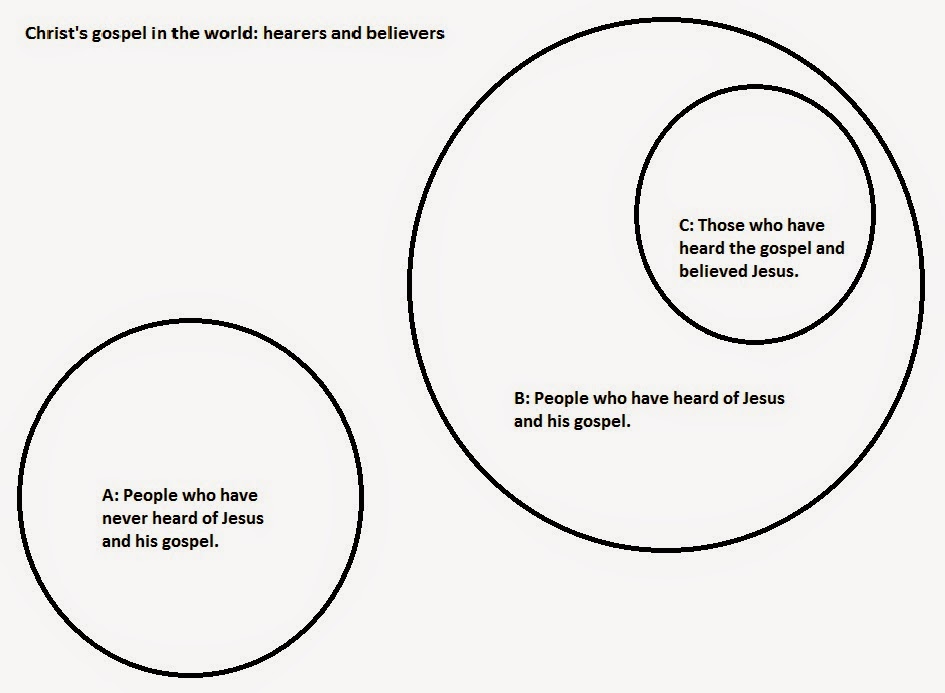
It is a perennial question in theology: If someone dies never having heard of Jesus, might it be possible for him, somehow, to be saved without the gospel? There is a curious feature embedded in the question. The question can only be formulated by those to whom it does not apply. So the question cannot arise in the only context in which it is significant.  As it is written, How then will they call on Him in whom they have not believed? How will they believe in Him whom they have not heard? And how will they hear without a preacher? How will they preach unless they are sent? (Rom 10:14-15) That makes me think the question is a theological curiosity, one of those things we can debate along with how many angels can dance on the head of a pin, rather than a question that is of serious use to anyone. It is all right--at least I feel no embarrassment about it--to say I simply know nothing about the answer. Think of a Venn diagram of three sets, those who have heard the gospel, ...

The true bride and the bimbos

In previous posts, here  and here , I put forth the problem of unrequited love between man and woman as analogous to people's rejection of God's love, and their condemnation to an eternity without God's favor as the result. It is not a perfect analogy but I think it is a sensible one. If the church is the bride of Christ, it is safe to say that those who reject him hold no such status--they could if they would, but they won't. This is rather like the situation of my unhappy young friend Jack. Anna could be the bride of Jack, if she would have it so, but she simply won't. Who in this world is (are) the bride of Christ? I would say, in a genial and ecumenical spirit, that it is all who love the Lord in sincerity. (Eph. 6:24) No narrower definition, such as just Catholics or just Protestants or only left handed evangelical Baptists, really does justice to what scripture is trying to tell us. Christ loves you. Love him back--the real Christ and not some false image o...

Ivory towers

Erasmus makes a very important point in the preface to his Manual of a Christian Knight . What most Christians need, most of the time, is good practical everyday Christianity, and that has little to do with the abstract wranglings of learned theologians. When put to practical use, in resisting evil and serving the cause of good, Christianity becomes a good deal simpler than the theologians make it out to be. If theology and the academic study of the faith is an ivory tower, the real work of the gospel gets done down at street level, and on the sidewalk out in front--in acts of kindness, mercy, forgiveness and truth telling, and in defying evil as it attempts, under one guise or another, to find its way into our lives.  What goes on in the upper floors of the ivory tower has little to do with the everyday, street-level work of the gospel. A point I've made before on this blog is that in the practical work of the gospel, Christians of various denominations look more alike than d...