Posts

Showing posts with the label legalist

Unclear but present danger

It is now evident that Christians unhappy with Christian progressivism will "walk apart," as one catchphrase puts it, separating themselves in worship and in polity from what they see as heresy. The heresy they see is an antinomian view of gay marriage and abortion, along with other symptoms of an ugly syncretism of culture and church that imports the culture's unbiblical ethics into the church. These conservative Christians see in their opponents a rejection of scripture's authority and the lessons of tradition. They will walk apart for the foreseeable future, hoping for changed hearts in those on the other side of the controversy, and awaiting the judgment of history. It seems like a solution that will do for the time being, though no one is really happy with it. But the devil is the subtlest creature we meet with. There is a trap. Among those Christians rushing away from antinomianism are some who embrace, instead, a mechanistic and legalistic understandin...

Misusing grace and law

Image
"The twin heresies, antinomian and legalist, are not two extremes with orthodoxy in the middle, but aberrations that deny the gospel, each in its own way. They are mirror opposites of one another but reflect only distortions." Here is a scripture that reveals a great deal about the nature of law and grace, and it occurs in the Old Testament. Examining it may surprise some people who think law versus grace is entirely a New Testament issue. 2 Chronicles 30:17-20 New International Version (NIV) Since many in the crowd had not consecrated themselves, the Levites had to kill the Passover lambs for all those who were not ceremonially clean and could not consecrate their lambs to the Lord. Although most of the many people who came from Ephraim, Manasseh, Issachar and Zebulun had not purified themselves, yet they ate the Passover, contrary to what was written. But Hezekiah prayed for them, saying, “May the Lord, who is good, pardon everyone who sets their heart on seeking ...

Fire and brimstone

It is a strikingly odd thought. You can work for Christian unity by preaching the wrath of God, for doing so is a corrective for both antinomian and legalistic heresies. There is an appalling tendency in some circles to preach about God's mercy without preaching about his wrath. As a friend of mine says, "If not for the wrath you don't need the mercy." That is very astute. Salvation is being saved from something. It is not only being saved from our own folly either, but from eternal consequences of that folly. It is fashionable to preach in an antinomian tone that suggests that all of the gospel is sweetness and light. That kind of preaching is not the whole counsel of God. It leaves the hearers thinking that bedrock Christian ideas about right and wrong are sort of optional and nice and it will be no great problem if you continue to do your own thing. God's grace will cover it, surely? That is a point of schism in the church world. If you do not take note...

A truly awkward question

Image
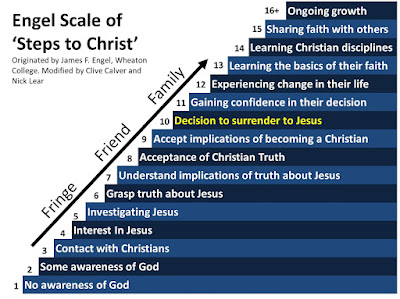
This is, as you see, the Engel scale, which tries to explain and gauge individual progress on the spiritual journey. Looking at it this morning I asked myself whether the same scale might apply to churches as well as individuals. I sometimes think of alarming questions, and this one alarmed me very much. What if there are church congregations that are nominally Christian, but in their preaching and teaching, and in the understanding possessed by the members, fall somewhere below ten on the scale? If there are some churches that are pre-Christian on this scale, but calling themselves fully Christian, then that has big implications for church unity. How can we unify with a church that is something other than what we ourselves mean when we say "Christian"? For it is clear that we and they would mean different things by it, if we are above and they are below step ten. In the hypothetical pre-Christian churches I am talking about, disciple making would be absent...

Immutable

If the gospel is indeed once given for all (Jude 1:3), then we do not have the option to adjust what it says to suit us better. If a thing is the truth, it is true whatever you think of it. If you have trouble with what it says, welcome to the club, for parts of the gospel are challenging to all of us. We may not all be challenged by the same parts, but all of us have to make some concessions and accept changes in ourselves as we become Christ's followers. If that were not true, there would be no reason for moral teachings to be given to us, because we would already be Christlike. That is a point that seems useful to emphasize--that we all need to change in the face of unchanging truth. There are many in today's church world who see it differently, apparently not believing in immutability as a characteristic of divine truth. I think their error is very great, and extremely dangerous to them. It is also destructive to unity among Christians. If you have one group that accep...