Posts

Showing posts with the label reason

A tale of two mentalities

There are two ways Christians talk to each other about the Christian faith. One way is "What Christianity means to me." Archbishop John Sentamu excels at this mode of explanation. Pope Francis's heartfelt if misunderstood forays into new thinking are of the same sort. Indeed, laymen are told and encouraged to "give their testimony," so it is a widely used mode of Christian expression, perhaps the widest. The other is to ask what Christianity timelessly is and requires. C.S. Lewis, Augustine, J.I. Packer and writers of that slant seek to separate the "me" out of it. Such people make everyone uncomfortable by implying that what it means to me might not be right, or at least, that my understanding might not be the central part of the story. One way looks inward. One way looks upward. Before arguing with someone, you should be very sure you know which kind of statement you are arguing with. It is seldom fruitful to inform someone that his interpreta...

Ian Hutchinson on science versus religion

I lately came across a really good presentation on why scientific reasoning cannot preclude the miraculous; read the whole thing on the Veritas forum: http://www.veritas.org/can-scientist-believe-resurrection-three-hypotheses/ Snippets from the article: I’m a professor of nuclear science and engineering at MIT, and I believe that Jesus was raised from the dead.  So do dozens of my colleagues. How can this be?... Science cannot and does not disprove the resurrection. Natural science describes the normal reproducible working of the world of nature. Indeed, the key meaning of “nature”, as Boyle emphasized, is “the normal course of events.” Miracles like the resurrection are inherently abnormal. It does not take modern science to tell us that humans don’t rise from the dead. People knew that perfectly well in the first century; just as they knew that the blind from birth don’t as adults regain their sight, or water doesn’t instantly turn into wine... Today’s wi...

The new rules are killing us

In present-day Western society, emotional arguments prevail even when calmer thought shows them to be baseless or ill-founded. Calmer voices are drowned out or booed off the stage. Today the crowd is booing a senior churchman who has his own take on Catholicism's sex abuse scandal. "The real scandal is that the Catholic church hasn’t distinguished itself from the rest of society. . ."   Society “forgets or covers up the fact that 80 per cent of cases of sexual assault in the church involved male youths not children,” [Cardinal Brandmüller] told Germany’s DPA news agency in an interview a few days ahead of his 90th birthday. Click the link to see the firestorm of response, and to read the very obviously slanted story reporting the controversy.  This man who is an officer in the church sees the church's problem as one of cultural syncretism, stemming from worldly indifference within the church toward homosexual conduct. He sees the church's sex scandal as ...

United in mind and judgment?

I appeal to you, brothers, by the name of our Lord Jesus Christ, that all of you agree, and that there be no divisions among you, but that you be united in the same mind and the same judgment.  (1 Cor 1:10) That was an easier thing to ask in the first century than in our day, because the problem was simpler.  The early church's doctrine was the kerygma , a call to faith based on news of what Christ said and did. This is the material that went into the four canonical gospels that have come down to us. To round out that teaching, the apostles wrote letters clarifying how to be a Christian, these were saved and circulated in the early church, and are now our New Testament epistles. The Old Testament was prized in the early church for its wisdom and for its prophecies of the Messiah. It was a time before formalistically systematized theologies were composed, denominational distinctives defined, and the associated battle lines drawn. Elaboratio...

You can do all that in C

In real life I program computers. Programmers have favorite computer languages. Mine is C, and I can always start an argument by saying we don't really need other languages. People who have other favorites then take umbrage and start a debate. It is common in the tech community to refer to such kerfluffles as religious conflicts, and that is unfortunately apropos. The parallelism with religious debates is striking. People describing the same things in different ways, pursuing the same answers by different means, instinctively see one another as doing something wrong. I say that a program variable is, in reality, simply a numbered position in the computer's memory, what is called in computerese an address. That is the wrong way to look at it, say proponents of the higher levels of abstract symbolism. What is important, they say, is meaning.  We sound like a bunch of theologians. I am coming round to the conclusion, after years of thinking about it, that ...

Hanlon's razor

"Never attribute to malice that which is adequately explained by stupidity." Wikipedia on Hanlon's razor: https://en.wikipedia.org/wiki/Hanlon%27s_razor On razor principles in general:  https://en.wikipedia.org/wiki/Razor_(philosophy)

Toward a solution. Part five: The Roman mistake

In the medieval era, Roman Catholicism became fascinated by elaborate reasoned arguments and took them to be the gold standard of theological truth. When the Protestant Reformation happened, the Protestant sects carried forward this tendency. Now there were several strands of argument, each claiming superiority. There is an underlying assumption in all of this that having the better argument means you have the better truth. I see this as an error of the Roman church, inherited by her Protestant daughter churches. Or, to put it another way, Protestants felt that in answering Rome they needed to be sophisticated in their arguments. It was, in their understanding, the way that theology needed to be done, with lots of complicated details worked out. The result? Root and branch, Western Christianity is obsessed with the intellect. Where this becomes a problem is at the point where intellectual justification supports unloving attitudes and actions. In the name of reasoned argument...

Toward a solution. Part three: The new commandment

Many in today's church world do not fully honor Christ's new commandment to us. If we did, it would have the result he stated. Christ calls on us to love other Christians as he has loved us, and said that by this sign all people would know we are his disciples. He prayed that we all would be one, so that the world would know that the Father sent him. Applying Christ's standard makes theological disputes look different. The Thomist and the Reformed may never agree with one another, but they will characterize their differences differently if they love one another as Christ does. We should all hope fervently that Christ does not reject us when we have imperfect theological understandings! So the new commandment impacts theological differences, not to make any stance right that is wrong in fact, but to make whatever wrongness there is a matter between brothers not foes. There is no room for nonsense about torturing you for your own good, or burning you at the stake for th...

I make up a word

Image
Deconsider: To remove from further consideration; to treat something as an irrelevancy. Ex: "It is time to deconsider a number of ideas we formerly thought essential." The word looks very useful and I hope its use catches on. The church world is going to need to deconsider a number of cherished divisive notions. Re considering our baggage from the Great Schism, the Dark Ages and the Reformation does not seem to do much good. We just go round and round and end up at the same loggerheads we started at. The East will not have a papacy of supreme power, the Protestants think church history began in 1517, or at least did something very important in that year, the Catholics think themselves unassailably right because, well, they're Catholics, and going over all of that again is a waste of time for everyone.

Doing, saying and thinking

Our Lord Jesus had something very revealing to say about false prophets: You shall know them by their fruits. He did not urge us to analyze the fine points of their reasoning or fault their grasp of systematic theology. Whatever they say, what they do won't turn out right. Notice that by pointing us to a test on that basis, he levels the intellectual playing field. Believers who might be fooled by a glib spokesman for a false idea need not be. They need only watch the result. I put a lot of stock in the test of results. I have seen Christians whose grasp of theology I find a bit lacking do works of mercy and kindness that make me take my hat off. I have also seen clever theologians support ideas that are unwholesome in practice when you look at what interests are actually served. In this connection I would cite recent Episcopalian revisions to the rite of marriage, which appear to be unhelpful even to those the revisions are meant to gratify. So even after we h...

A popular message

Image
via Facebook

Reality, fantasy and ecumenism

By Charles Marsh Recent conversations online and off have shown me something very curious. Some of what I believe to be Christian verity some other Christians take to be mere fantasy. They are cessationists and I am not . According to them, the things that I believe about tongues and prophecy and words of wisdom and of knowledge are sheer moonshine. So while in some churches I am thought orthodox enough, in others I am regarded as delusional or something rather like it. There are other matters in which, in like manner, some Christians view certain beliefs of other Christians as no better than free imagination, runaway fantasy or perhaps something worse: damaging falsehoods not harmless nuttiness. I admit to being somewhat dismayed by other Christians' newspaper novenas and Facebook prayer schemes. I do not think that is how prayer works. Their idea seems to be that if you repeat such and such a prayer x times, or republish it or "like" it or retweet it, then you w...

The deconstruction of love

Image
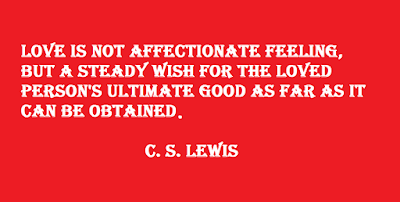
By Charles Marsh Secular society has wrecked itself utterly in the matter of how, typically, women and men in love relate to one another. The secular view is that love is all about attraction and affection and that it is measured by the strength and urgency of our feelings. Quite often the secular thinking is echoed and believed by people in the church, to their detriment. I would like to draw this to the attention of both women and men. We need to reexamine relationships and how they work. What we do, based on wrong expectations, is find someone who sparks our flame and stokes our fire and think we have thereby found a candidate to give us lifelong bliss. We have the qualifications wrong because the job of wife or husband is actually a bit more involved than tab A into slot B. The wrong understanding is the result of a secular worldview that excludes the supernatural, exalts the merely material and physical, and sees people as meaty machinery rather than liv...

Ivory towers

Erasmus makes a very important point in the preface to his Manual of a Christian Knight . What most Christians need, most of the time, is good practical everyday Christianity, and that has little to do with the abstract wranglings of learned theologians. When put to practical use, in resisting evil and serving the cause of good, Christianity becomes a good deal simpler than the theologians make it out to be. If theology and the academic study of the faith is an ivory tower, the real work of the gospel gets done down at street level, and on the sidewalk out in front--in acts of kindness, mercy, forgiveness and truth telling, and in defying evil as it attempts, under one guise or another, to find its way into our lives.  What goes on in the upper floors of the ivory tower has little to do with the everyday, street-level work of the gospel. A point I've made before on this blog is that in the practical work of the gospel, Christians of various denominations look more alike than d...

Tale of the centuries

We are nearly a thousand years on from the East-West Orthodox schism, and coming up on five hundred years since the North-South Protestant schism. Ever since, and for all this time, the theologians have been working on arguments against unity not for it. They have strengthened their positions, circled their wagons and dug foxholes. You can never trust a theologian with anything important. He will forget what he is about, set his teacup down somewhere, forget where he put it, and go off and hatch a controversy. Think about it and you will see why he is not very useful for the work of peacemaking. His job description is to create and defend arguments. Well, we have been arguing now for a thousand years, often over the selfsame questions with which we began. If you are seeking a peacemaker, do not look among the men who specialize in arguments .

Scattering and gathering

Image
We do not need to consider compromise the only way toward agreement. This is a scatter diagram. It is something useful in science and engineering. It shows all the degrees of variation with which instances of something occur. This kind of diagram gives you a picture of how much variation there is in something. An average shows you where the middle of something is. A scatter shows you the opposite: It shows you, all spread out, the variations that go into the average. Today's Christians are scattered all over the place on what they think about various and sundry matters pertaining to the faith. You could draw diagrams of the variation in belief on things like Holy Communion, the mode of baptism, the veneration of saints, and other things. I would say that there is just one perfectly true belief about any one of those things, of which our divergent beliefs are variations. That is to say, a maximum of just one belief on any topic can be exactly right. It could be that we ...

From cause to effect

Paul the apostle remains, despite his detractors ,  a beloved teacher to much of Christendom, who bequeaths us some astonishing and useful insights. Here is an excerpt from Galatians chapter five: 16  So I say, walk by the Spirit, and you will not gratify the desires of the flesh. 17  For the flesh desires what is contrary to the Spirit, and the Spirit what is contrary to the flesh. They are in conflict with each other, so that you are not to do whatever you want. 18  But if you are led by the Spirit, you are not under the law. 19  The acts of the flesh are obvious: sexual immorality, impurity and debauchery; 20  idolatry and witchcraft; hatred, discord, jealousy, fits of rage, selfish ambition, dissensions, factions 21  and envy; drunkenness, orgies, and the like. I warn you, as I did before, that those who live like this will not inherit the kingdom of God. Discord , ambition, dissentions and factions are a big part of what ...

Science versus religion is a phony issue

By Charles Marsh The problem is that science, well suited to look at repeatable events, is at a loss about singular ones.  Some people suppose that science trumps religion, that a modern understanding of the world through science renders religious understandings obsolete. Some others suppose that religious understanding can be used to refute science. Both views are wrong. Science is rooted in philosophical naturalism. That is the stance that says we will explain what we see without reference to supernatural agencies. Science describes what happens without recourse to explanations involving angels, demons, gods, fairy godmothers, humors, vapors or ghosts. Acting on this basis, science has done a great deal of good. It has gotten rid of superstitions about what causes disease, where insects come from and a good many other misunderstandings. Notice that science is morally neutral. The same disciplines that give us vaccines and disease prevention can as...

The gay marriage dispute is irreconcilable

The approval by some churches of homosexual marriages, and the view of other churches that this is no tenable doctrine at all, raises an interesting dilemma. Both camps cannot be right, since each says something directly contradicting the other. One view of marriage or the other is false prophecy, and those on one side or the other of this question false prophets, if we understand prophecy in the sense of declaring the mind of God. Or one idea or the other is a false teaching, and those putting it forth false teachers, if you prefer that term. We can see that there is no middle ground; if a thing is so, its opposite can't be. Perhaps in our benighted era there are people who believe that a thing can be not so and also so, depending on some subtle idea of context and experience: 'True for you but not for me.' I suggest that relativistic thinking of the kind is incompatible with Christianity. Divine revealed truth is not a matter of what you or I would like. ...

Believable versus believed

What was saving faith in the first century is still so in the twenty-first. We need add nothing to it. There are two classes of Christian belief. One kind you must believe or you are no Christian, in any historically intelligible sense. The divinity of Christ, the uniqueness of his mission, the authority of his teaching, the triune nature of God in revelation, the centrality of love and forgiveness in Christian life, these are some examples of the faith once for all delivered to the saints. There are other things that are believable if you are a Christian, but they do not have the same centrality. They do not need to be believed. Into this basket I would sort the things you believe because you belong to one church or another: opinions you hold that make you a Calvinist versus an Arminian, for example, or the Catholic versus Protestant controversy about whether or not you should invoke saints in your prayers. These later controversies clearly do not have the same we...