Posts

Showing posts with the label blind leading the blind

Toward a solution. Part six: Focal point

I find my ideas have grown and changed in the years since I took up the question of Christian unity. I have found a consolidating theme for my reasoning, and single point of focus, in Christ's new commandment that we love one another as he has loved us. I now take as first principles that this commandment is an achievable goal and that in general, we are failing to achieve it. Starting from that point makes a clear question for us to examine. How and why are we failing? One or more of the following reasons may be at work in the lives and faiths of various people. I do not suppose the list is complete but it is a fair start. I may add to this list from time to time as more reasons occur to me. I should point out that I am guilty of any charge I make, below, or a great many of them, so this is not a matter of criticising from a superior stance. I would say we are all in this together. Reasons we fail at Christ's new commandment: We don't believe success is possible...

Crazy old man with a ball

Well, well. I sought God for the answer to a thousand-year-old defect in the life of the church, he pointed me to a single verse in scripture that explains and solves the problem, and the answer was so simple that it took me a while to see it. He then pointed me to the echoes of that verse in the rest of scripture. Yes, it is official Christian doctrine that we are to love one another as Christ loves us. We don't, by and large. Well, there is my answer to the question I took up some years ago, the question of why we have a disunified Christendom and what we can do about it. I am going to take this ball and run with it, make it a personal crusade to show my answer to the brethren, for it seems to be an answer that has eluded the wise and learned but is the right one. Some, doubtless, are going to think me a crazy old man. While they may be right on other grounds, it is not crazy to say that the matter is in the scriptures, right there on the page, and our failures are obvious. ...

Examine yourself

St. Paul twice exhorts us to examine ourselves. Once, to ask if we are truly in the faith. He means this as first-century converts would have understood it. Christ said that whoever heard his words and believed God who sent him had already passed from death to life. The only thing first century Christians knew about Christ was what he said and did. Paul isn't asking for an exegesis according to Thomas Aquinas or Karl Barth. Paul exhorts us in another place to do it, examine ourselves, before taking communion, lest we be guilty of the Lord's body and blood. I think he meant the same thing both times.

Pop Christianity

Image
I am pleased to report that many people of my acquaintance, pastors and teachers in various denominations, are speaking out against lightweight, cheap grace, thoughtlessly feel-good Christian sentimentality, and against the moral lawlessness that frequently accompanies a gospel of all sunshine and lollypops. A gospel that speaks as if the Christian life is free of trials and torments and troubles makes me wonder just how that is even slightly plausible, but there is an answer of sorts in Hebrews 12:7-8. via  http://www.whatisthegospel.org.uk/ A related ill in the church world is thinking that it is not nice or proper to talk much about our trials. That idea is all wrong--we should talk more about our trials. If we do not tell others what is going on with us, we may lead other people who have troubles in life to think their problems are somehow new and different, despite 1 Peter 4:12-13. It is not quite a matter of misery loving company, more a matter of helping others ...

Tales from the crypt

Image
Presiding Bishop Michael Curry As you perhaps know already, the primates of the Anglican Communion just concluded a week of closed-door meetings in the crypt at Canterbury Cathedral. The Episcopal Church, USA, was censured for moving forward with gay marriages, counter to the doctrine of Anglicanism in general. It is a clear affirmation of historical orthodoxy by the Anglican mainstream, but the rebuke was a lighter one than some traditionalists wanted. Here is the sentence passed upon the Episcopal Church by the gathered primates: “It is our unanimous desire to walk together. However given the seriousness of these matters we formally acknowledge this distance by requiring that for a period of three years The Episcopal Church no longer represent us on ecumenical and interfaith bodies, should not be appointed or elected to an internal standing committee and that while participating in the internal bodies of the Anglican Communion, they will not take part in decision making on ...

November 1, 2015: Gay weddings for Episcopalians

"I write more posts about marriage, homosexuals and homosexual marriage than I would like, but this is a blog about Christian unity, which means it is also about schisms, and gay marriage is a hugely schismatic issue these days." The Episcopal Church USA has formally approved gay weddings, and the go-live date for the policy of allowing such weddings to proceed with the full approval of the church is today, November 1, 2015. Here is a background article explaining the Episcopal Church's new policy:  http://www.christianpost.com/news/us-episcopal-church-approves-same-sex-marriage-replaces-terms-man-and-woman-with-couples-141163/ And here is a rather self-congratulatory page on the Episcopal Church website, pointing out the church's stances on LGBT matters:  http://www.episcopalchurch.org/page/lgbt-church The Episcopal Church's long unfolding of progressivist policies toward homosexuality has already caused schisms and tensions with more conservative Anglic...

Meanwhile, in Germany...

Pastor Olaf Latzel of Bremen, Germany finds that the church scene in his country is soft on truth, soft on gospel fundamentals. He is trying to wake things up. In the process, he is getting flack for saying things that once were unremarkable when said by Christians. Story via CBN, read it here: http://www.cbn.com/cbnnews/world/2015/October/Pastor-Pays-Price-to-See-Germanys-Spiritual-Revival/

Anglican soap opera

Image
Interesting summary in the online Washington Post about the ongoing soap opera that Anglicanism has become. Those interested in Christian unity are well advised to study schisms taking place right in front of them, in their own lifetimes, not just historical schisms. Excerpt: The Anglican Communion is already divorced  By Trevin Wax | Religion News Service September 21   Is the Anglican Communion about to split over different views of sexual ethics?   You might think so after reading headlines about the archbishop of Canterbury’s proposal to “loosen” the structures of the Communion — a way of retaining his relationship to the liberal wing of the Western churches as well as the traditional Anglicans of the Global South.    But to interpret the archbishop’s recent announcement as a split over sexuality is to miss the bigger picture. . . "  Read more:  The Anglican Communion is already divorced (COMMENTARY) - The Washington Pos...

I'm a Christian, but...

Image
Nice takeoff on the rather vapid "I'm a Christian, but..." theme that is running around on the Interwebs these days. Hat tip to Lutheran Satire  for skewering this silliness right where it deserves.  .

Cessationism on the duck farm

Image
This is a duck. I, of course, as a Christian with Pentecostal leanings, am hard to sell on cessationism . It is like explaining to a duck farmer that ducks are extinct, like the dodo. So, what is that pudgy bird I just saw waddling by and quacking? The cessationist can only answer that what I saw isn't really a duck. On such a view, a word of knowledge that proves true and useful was just a really good hunch. Something similar is said of a prophetic utterance that brings clearer light to a situation--it was just really good extemporaneous preaching manufactured by the speaker's subconscious. Tongues in contemporary use are simply gibberish and interpretations are the same, or at best, like the so-called prophecy, a sensitive use of intuition. A great concern of cessationist theology is that new prophecy might somehow undermine the authority of scripture. But how can that be, when real deal Pentecostals and charismatics use scripture as their yardstick? The canon is clo...

A truly awkward question

Image
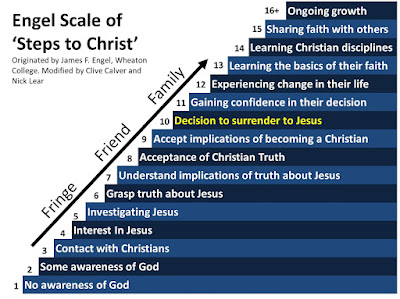
This is, as you see, the Engel scale, which tries to explain and gauge individual progress on the spiritual journey. Looking at it this morning I asked myself whether the same scale might apply to churches as well as individuals. I sometimes think of alarming questions, and this one alarmed me very much. What if there are church congregations that are nominally Christian, but in their preaching and teaching, and in the understanding possessed by the members, fall somewhere below ten on the scale? If there are some churches that are pre-Christian on this scale, but calling themselves fully Christian, then that has big implications for church unity. How can we unify with a church that is something other than what we ourselves mean when we say "Christian"? For it is clear that we and they would mean different things by it, if we are above and they are below step ten. In the hypothetical pre-Christian churches I am talking about, disciple making would be absent...

Squishy, limitless, radical grace

Image
Grace is given to us not so that we can excuse our own sinful purposes but so that we can fulfil God's higher and better purposes for us. The misuse of God's grace to excuse (not only forgive) things God calls sin is the problem leading to schism. "Go and sin no more" turns into "go and sin."  Love does not mean that one is infinitely indulgent. God is infinite in love, but his word promises us either his mercy or his wrath. Of course it does not diminish the goodness of God that some people will not like their eternal outcomes. God is good, whether or not you choose to join into that with him. We risk doing the sinner no good,  but harm instead, when we assure him that whatever his moral failings, God's grace is sufficient for him. While saying so is true in a very real sense, it is dangerously misleading if the statement is not carefully qualified. Antinomianism is false, after all, and it comes to us speaking those very same words. It is dange...

The Third Samurai

The Emperor of Japan invited the best swordsmen in the land to an audience in his palace in Edo. As it was summer there were flies buzzing around. A swordsman pulled his sword from its scabbard and, with a shout, cut a fly out of the air, neatly cutting it in half. Not to be outdone, another swordsman pulled out his sword and cut a fly into two pieces before it fell. A third swordsman drew his sword and cut, but the fly flew on its way and did not fall. The Emperor glared at the third swordsman. "Majesty," said the third samurai, full of bravado, "That fly will never reproduce!" I put this forward as a cautionary tale for all to ponder. If your efforts do not have evident results, you need not explain. We have enough pretense going on already in the fly-ridden palace that is Christendom today.

Again, Anglicanism

As I have noted before , Anglicanism is a splendid possibility to consider when thinking about what one church for all believers might look like. Anglicanism accommodates catholic and reformed streams of faith and practice, and variations within those streams. In today's Anglicanism you find charismatics and Anglo-Catholics, determinedly "low church" worshipers who like to keep things simple, evangelicals, Reformation doctrine buffs and more than a few open-minded believers who are comfortable in all those settings. Unfortunately, heterodoxy set in during our era, as some people exploited Anglicanism's genial tolerance that gave countenance to a range of ideas and opinions that all--until recently--stayed within the pale of historical Christian orthodoxy. Here Fr. Gavin Ashenden takes a look at what went wrong--the current split-up in progress in Anglicanism, as the orthodox take stock of what has become of their church:  Leaving home: The Future of the Faith in...

Whither Anglicanism?

The Anglican communion's plural viewpoints and differing worship styles with, at the same time, unity of church administration, is appealing as an example of how a single church for all believers might work. But in recent times a problem has arisen with its model. Some have used the Anglican tendency toward genial tolerance of varying views to bring into the church ideas that are heterodox at best, importing passing fashions from the culture as new standards for Christianity. It will be interesting to see how (or whether) the Anglican communion recovers from that. That said, Anglicanism is uniquely positioned to serve as a vehicle for dialog, since it is a Protestant church with Catholic roots and Orthodox affinities. As an entity that can point to its continuous existence and operation from long before the Great Schism of 1054, it can claim kinship to the undivided Church of old, something no other Protestant body can do. At the same time, it is accepted as a Protestant church ...