Posts

Showing posts with the label partly Christian

The limits of inclusivity

Image
Dr. Gavin Ashenden here takes a stab at defining what is beyond the pale of historically orthodox Christianity. Willingness to repent and be remade into someone new he sees as the sine qua non for becoming an authentic Christian. Remaking the faith instead will not work.  Attempts to do so leave you with less than the truth. I think that is a good starting point for discussions of where Christianity's boundaries lie, because it is even-handed toward all of us sinners. 
Whither the West? A response to Christianity's decline

Western culture's rejection of Christianity is not entirely a bad thing. A certain amount of cultural Christianity was always fake. I do not wholly accept the postmodernist idea that claims of truth are really clandestine attempts to get power over other people. But some percentage of truth claims work like that. The use of religion to manipulate is a danger. Some people try to use it that way. So long as the culture saw adherence to Christianity as a virtue, some people played at Christianity for that reason,  sometimes not even seeing that they had missed the point.  Some, whether cynical or misguided, used Christianity as a road to their own prestige and influence. The point they missed: Christ's kingdom is not of this world and our view of it ought to rise above its secular manipulation to see its higher purpose. Is the purpose of Christianity to make the world a better place? Some adherents of syncretic blends of culture and Christianity would say so. But...

A truly awkward question

Image
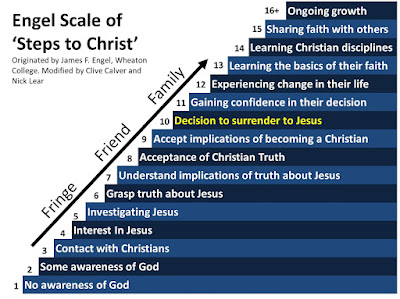
This is, as you see, the Engel scale, which tries to explain and gauge individual progress on the spiritual journey. Looking at it this morning I asked myself whether the same scale might apply to churches as well as individuals. I sometimes think of alarming questions, and this one alarmed me very much. What if there are church congregations that are nominally Christian, but in their preaching and teaching, and in the understanding possessed by the members, fall somewhere below ten on the scale? If there are some churches that are pre-Christian on this scale, but calling themselves fully Christian, then that has big implications for church unity. How can we unify with a church that is something other than what we ourselves mean when we say "Christian"? For it is clear that we and they would mean different things by it, if we are above and they are below step ten. In the hypothetical pre-Christian churches I am talking about, disciple making would be absent...

From cause to effect

Paul the apostle remains, despite his detractors ,  a beloved teacher to much of Christendom, who bequeaths us some astonishing and useful insights. Here is an excerpt from Galatians chapter five: 16  So I say, walk by the Spirit, and you will not gratify the desires of the flesh. 17  For the flesh desires what is contrary to the Spirit, and the Spirit what is contrary to the flesh. They are in conflict with each other, so that you are not to do whatever you want. 18  But if you are led by the Spirit, you are not under the law. 19  The acts of the flesh are obvious: sexual immorality, impurity and debauchery; 20  idolatry and witchcraft; hatred, discord, jealousy, fits of rage, selfish ambition, dissensions, factions 21  and envy; drunkenness, orgies, and the like. I warn you, as I did before, that those who live like this will not inherit the kingdom of God. Discord , ambition, dissentions and factions are a big part of what ...

J.I. Packer puts his finger on it

J.I. Packer, no stranger to thinking Christians in or out of the Anglican Communion, in 2007 published the short booklet "Taking Christian Unity Seriously." It's free to download here: https://static1.squarespace.com/static/5925e7646a49636041956a8d/t/5952cbfb440243684b92b980/1498598397404/07-Taking+Christian+Unity+Seriously.pdf It is part of a series of booklets called The Anglican Agenda (Ginger Group) series, all of which may be read here: https://www.anglicannetwork.ca/resources/ "Taking Christian Unity Seriously" frames the question of unity in light of a notable disunity, the Anglican Communion's strife over efforts within it to approve homosexual conduct and same-sex marriages. Packer frames a scriptural case for what unity actually means and concludes it does not mean compromising about that. There are points upon which one cannot compromise without doing violence to the very religion one is trying to unify. Here are a few quot...